Showing posts with label hiking. Show all posts
Showing posts with label hiking. Show all posts
Sunday, June 2, 2013
Mother Daughter Adventures on the Appalachian Trail
Over Memorial Day weekend, my daughter and I, in addition to a friend and her daughter, section hiked the Appalachian Trail in Maryland. We shared challenges and adventures and created memories that will last a life time. We learned that our daughters are strong, can persevere and meet many obstacles with smiles (yes, there were grumbles but usually when they were hungry!). We are so grateful to have shared this experience with them. And, we are so proud. We hope this will inspire many mothers and daughters to seek adventure on the trails together.


Thursday, November 15, 2012
Thanksgiving Traditions: Establishing New Ones on Trails

Thanksgiving oozes family tradition - going to grandma's house, volunteering at a soup kitchen, making the passed-down family recipe, watching football or the parades in PJ's or taking a hike. After years of wrangling with traffic in the the northeast, my husband and I decided, no more, enough was enough of the exhausting eleven hour stop-and-go traffic and decided to stay put at home. Thus, it gave us the opportunity to establish our own traditions and invite others to join us.
Whether it is cold, rainy or the most beautiful azure skies, we take a hike. We stuff the turkey to capacity, stick it in the oven, put on our hiking boots and venture close to one of the many trails the DC region has to offer. The trails are quiet and peaceful because so many have escaped the political hub to find rest and relaxation. Instead, we retreat to a trail to celebrate each other, our family unit, the bounty in our lives and the ability to adventure together in the great outdoors. Besides sitting down to gorge on a tasty meal and share our gratitude, hiking as a family on Thanksgiving allows us to relish each other and just be.
What traditions are you thankful for on this Thanksgiving?
Tuesday, October 30, 2012
Celebrating our Outdoor Selves

A theme that continually popped in my head when reading the last 100 pages of "Up: A Mother and Daughter's Peakbagging Experience" by Patricia Ellis Herr was her humble nature to praise her daughter Alex and not herself. Patricia leads her daughter on a journey to peak bag the forty-eight 4,000 foot White Mountains when Alex is age five and six. Yes, Alex is a unique child to one, want to do this but second, follow through to completion. I would like to praise her mom though. Patricia does not give herself a high five in the book for one, seeing and acknowledging Alex's desire to summit all 4,000 foot peaks in the Whites; second, learning the art of hiking in the Whites; third, leading her daughter safely up each peak; and fourth, acknowledging her own desire to summit all 48 and then completing this achievement. It struck me that throughout the book, she continually wrote, intentionally and inferentially, how much of this adventure was her daughter's and not her own. At the end of the book, she finally acknowledges her own accomplishment and admits that she selfishly invested in this adventure for herself and not just for Alex. Why at the end of the book? Why only one sentence about it? Mothers are nurturers. We are giving: of ourselves, our time and our energy. Our giving is unconditional. Often receiving (and sometimes wanting) nothing in return; except for maybe love. This is the theme of another recent book I read, Brothers and Me by Donna Britt. She chronicles her life of giving: to her brothers, her husbands and her children. It isn't until the end of the book that she realizes giving is selfish - in a good way. Giving is purposeful, even if done subconsciously, because it allows the giver to feel good about herself. Donna acknowledges and gives her readers permission to feel okay for selfishly giving to others, whether to their family, friends or community. This was my own revelation about myself when reading Brothers and Me which allowed me to read Ellis's book with a new set of lenses.
Patricia gave unconditionally to her daughter's peakbagging adventure. As she explains in her book, she wants to foster and not inhibit her daughters' passions and desires for exploration. Her story is an example of how mothers give consciously and subconsciously to help their children fulfill their dreams and aspirations. Patricia deserves a high five for being a giver but also for finally acknowledging her accomplishment, even if it was brief and at the end of the book. Most importantly, I celebrate her because she selfishly had a vision to climb all forty-eight, 4,000 foot peaks in the White Mountains with her daughter. She implemented her vision and accomplishment it. Yes, Alex did it and that is amazing. However, Alex couldn't have done it without her mom. In her story, Patricia exemplifies a mother with a strong mind, body and spirit that made choices to adventure and accomplish. I celebrate her!

Saturday, August 25, 2012
Trail Discovery for Kids: Lake Artemesia
View Larger Map
August 2012
Highlighted Hike
Lake
Artemesia Trail
Berwyn Heights, MD
Trail Description
ü This 1.4 mile circuit
hike on a hard surface trail is just across the railroad tracks from the
University of Maryland in College Park.
ü The trail circles
the 38 acre Lake Artemesia with no elevation gain or loss.
ü To find Lake
Artemesia, use Interstate 495 and take Kenilworth Avenue south to Greenbelt
Rd/Rt. 193. Turn right and drive three quarters of a mile. Turn right onto
Branchville Rd. which goes under the railroad tracks and turns left and becomes
Ballew Ave. Make a left into the parking lot just after the stop sign with
Berwyn Rd. Follow the trail along Ballew Ave. to the gate of Lake Artemesia.
ü The trail is stroller
and bike friendly.
ü See the trail map
image to the right.
Age Appropriateness
This hike is appropriate for children of all
ages but especially great for toddlers and preschoolers.
What is fun for
kids?
ü The park has two
floating docks for fishing. Children younger than 16 do not have to possess a
license.
ü The park has seven
gazebos, one raised above the lake, to seek shade, rest and watch wildlife.
Many benches sit along the trail and throughout the park.
ü Wildlife seen
includes: Eastern Painted turtles, Snapping Turtles, Bullfrogs, Green Frogs,
Great Blue Heron, Egret, Wood Ducks, and Mallards. The lake is a migratory
ground for many birds.
ü Watch the metro and
trains travel by the western side of the lake.
ü Beautiful water lilies
that bloom in July. A few blooms were still alive in August.
ü There are a few
large open green spaces for a picnic or a game of tag.
ü The Lake Artemesia
Trail is part of the Anacostia Tributary
Trail System providing miles of trails in Prince Georges and Montgomery
counties. From the park, the Paint Branch, Indian Creek and Northeast Branch
trails can be accessed.
ü Lake Artemesia is
metro accessible from the College Park station on the green line.
Caution
ü Swimming, boating
and ice skating are not allowed on the lake.
ü A majority of the
trail is exposed to the sun and lacks shade.
Thursday, August 16, 2012
What I Learned About My Kids (and Myself)
 |
| Looking at Mt. Lafayette and Lincoln at Lonesome Lake |
 |
| Greenleaf Hut |
Before
last week, they have hiked 8 miles in one day, carried a backpack on short
distance backpacking trips and hiked over 1,000 feet in elevation on a short
trail. I combined it altogether to hike two AMC huts in the White Mountains. I
was confident they would rise to the challenge. The challenge for me was keeping
my sometimes impatient nature in check and being the most positive, patient
mommy when the going got tough (more on that later). Huge insights learned:
- My son is internally motivated. He didn't need me, his sister or anyone else to get him up the mountain. He enjoyed the physically challenge. Often he said, "mom, this is fun." He had his moments on the second day when his little feet developed hot spots. I was grateful he communicated with me. We patched his feet a few different times and he was good to go never developing blisters. That would have definitely slowed him down. Often he was the lead encouraging us with his bouncy steps to maintain a presence behind him.
- My daughter is externally motivated. However, garnering that motivation from her mother is not the key. Instead, I received the whines of, "I'm tired or I don't want to do this anymore." Her brother can sometimes provide that motivation through competition. However, her peers and friends are the best motivators. Stalling up the mountain and complaining was the name of the game on the first day. By coincidence, we ran into neighbors at the Lonesome Lake hut. The three girls, older than her, helped motivate her to hike the difficult trail to Greenleaf hut. Upon reaching the hut, she would normally have been done for the day but she decided to summit Mt. Lafayette with the girls. The reward was the beautiful view. The reward for me was her telling me with a smile that the view was beautiful. This meant it was well worth the physical effort.


Each of
these challenges in the outdoors allows me to work on my patience with my kids,
in particular my daughter. I want them to learn about and explore their
physical limits. I want to model for them that going beyond reaps rewards of
greater self-confidence.
Thursday, July 19, 2012
Top 5 Family Adventures in Yellowstone and Grand Teton National Parks
 |
| Snow ball fight on Rendezvous Mountain |
 |
| Hike on Bunsen Peak |
Discovering
our national parks with my children is a dream that I am making a reality one
summer at a time. Two summers ago, we started with Great Sand Dunes National Park in Colorado. Last year, we went to Acadia National Park for four days ofadventure in the rain and sun. This summer, we ventured to Grand Teton,
Yellowstone and Rocky Mountain National Parks. The following are the best
family adventures in both Grand Teton and Yellowstone.
- Ride the tram in Jackson Hole Mountain Resort and hike the Rock Springs Trail into Cody Bowl - Although this is just outside of the Park, it was the most fun our family had while there. We rode the 100 passenger tram from the base of Jackson Hole to the top of Rendezvous mountain, a four thousand foot climb. We packed a picnic lunch for our day's adventures at the top of the world. We descended along the ridge line on the Rock Springs Trail into Cody Bowl. We spent our afternoon having snow ball fights, sliding down the glacial snow and rock scrambling. Afterwards, we treated ourselves to homemade waffles at Corbett Cabin. Yum!
- Kayak (or canoe) Colter andHalf Moon Bays - We rented two two-person kayaks from the Colter Bay Marina for half a day of paddling and wildlife viewing in Colter and Half Moon Bays.
- Hike around String and Jenny Lakes to Hidden Falls and Inspiration Point - We hiked 7.8 miles along the north and west sides of both String and Jenny Lakes. This route is gentle with minimal elevation change. The best part of this hike is taking in the mountain peaks and the lake vistas.
- Raft the class I and II rapidsof the Snake River - This activity was my son's choice. Grand Teton LodgeCompany was our guide down the Snake River in the Park. This float is gentle enough for a six year old. Daniel, our guide, was experienced at navigating the river and very knowledgeable about the natural history of the Park. We were fortunate to spot two moose, a beaver and an eagle.
- Camping - Camping is the best way to truly experience everything a national park has to offer from scenery to education. Grand Teton offers five first-come-first-serve campgrounds. They do not take reservations; however, visitors are able to easily get a site in one of the campgrounds. At the entrance stations and visitor centers, there are campground boards providing information on the availability of sites and at what time the campground became full.
Yellowstone
1. Circuit hike along the south
rim of the Grand Canyon of Yellowstone to Lily and Clear Lakes - The best way
to see the Grand Canyon of Yellowstone is to take a hike along the South Rim
Trail, in addition to Lily Lake and Uncle Tom's Trail. The Lily Lake trailhead
is at the far end of Artist Point. The trail follows the steep ledges of the
Canyon before it enters a pine forest and by two small lakes and thermals.
Uncle Tom's Trail gives all visitors a cardo workout climbing down and up 328
steps. At the bottom, you stand at the base of the lower falls to feel mist on
your face.
2. Take a picnic dinner to an
overlook in Lamar Valley to watch animals - If there is one national park known
for wildlife; it is Yellowstone. We grabbed fixings for a picnic dinner and
drove into Lamar Valley. This valley is stunning. My children learned a
valuable lesson from animal spectators fitted with their large scopes about why
preserving this valley's habitat is vital for the balance of the ecosystem. In
the valley, we watched hundreds of buffalo and looked for bear and wolves.
3. Hike to Bunsen Peak - Have you
ever want to bag a peak with your kids? Bunsen Peak is a good one to do. The
hike is a moderate 2.1 mile trek to the peak on switchbacks. The views at the
top are well worth it. The climb was a good challenge for my kids but they
loved skipping down the mountain.
4. Walk the Fountain Paint Pots
boardwalk - This was the touristiest adventure of our time in Yellowstone
because everyone wants to see the geological thermals. They are well worth the
crowds. This was my son's favorite part of Yellowstone.
5. Camping - Yellowstone offers both
reservation only and first-come-first-serve campgrounds. The reservation only
campgrounds usually fill well ahead of time. The first-come-first-serves are in
beautiful locations in the park but have limited, such as vaulted toilets.
 |
| Reading about thermal cones |
 |
| Lower falls in the Grand Canyon of Yellowstone |
 |
| Looking for wolves in Lamar Valley |
 |
| Kayaking in Colter Bay |
Friday, July 13, 2012
Mother Nature's Adventures: Check Your Attitude

Have you
ever ask yourself, "why do I camp?" I have. Even though I love to
camp, there have been a few times when I thought, "camping is a pain in
the butt." One those times was recent when camping in the National
Arapahoe Recreation Area outside of Rocky Mountain National Park.
Mother nature can really throw a curve ball
sometimes. It did the three days we spent camping and hiking in the Rocky
Mountains with mine and my brother’s kids. Each morning we woke
to a beautiful blue sunny sky but by early afternoon the storm clouds rolled in
during two separate hikes in the mountains. Both storms produced thunder and lightning:
one with rain and the other with hail. All eight kids have never hiked so fast.
Even though it was scary, it provided a great teachable moment for them.
By late afternoon when we returned to our
campsite from hiking, those same storms rolled into the basin of the mountains.
Our campsite was beautiful; a 360 degree view of the mountains and Lake Granby.
Best view ever! The downside was there were no trees. The pine bark beetle
killed all the trees in the campground. Therefore, when the storms hit each
evening; winds gusted up to 60 mph. Sometimes rain and lightning came with it.
We could see the storms approaching from the west, providing us some time to
prepare for cover.
Of course, the storms hit us during dinner
preparation on all three evenings. On the first evening, we used the backend of
our car as a wind shield when cooking the beef for burritos. We were
interrupted by rain. We shoved the pot under the car and ran to the tents. On
the second night, the storm hit just before dinner prep. After a late start, we
thankfully had a beautiful and relaxing dinner of which we didn't have to worry
about flying food, napkins and spilled drinks.
The third night's storm was the worst with
the highest winds - dirt swirled around us and the tents poles bent against the
wind begging to snap. My sister-in-law and I thought the dark clouds to the
west were far enough away that we could prep dinner and eat. The chili was made
and we were reading the directions to the rice when the strong gusts
began. The winds threw the garbage,
utensils, paper towels, stove windscreen, and the entire one pound box of rice
off the table. We scrambled to pick up everything, move the stove and chili
into the fire ring, salvage some of the rice on the gravel, place the remaining
items into the cars, prevent the tents from flying away, and instruct the kids
into the tents. My sister-in-law and I
got into our tent to anchor it down. My husband braved the high winds to cook the
rice in the fire pit with the wind screen. The kids laughed and created their own adventures in spite of the storm.
After thirty minutes of holding up the tent,
it was time to eat. We were losing day light and were hungry. We devised and
executed a plan to move the cars to create a wind shield. We gathered the food
and utensils and called the kids. All twelve of us, sat on the asphalt, in a
circle, sheltered by the wind, to eat chili and rice. It was the best dinner.
After three frustrating afternoons and
evenings of dealing with Mother Nature, we laughed at the ridiculousness of our
situation and ways of coping to maintain a smile on our faces for our children.
Mother Nature can through us curve balls when we camp but it is the attitude
for which we choose that creates the experience.
Tuesday, July 3, 2012
Be Grizzly Bear Aware
 |
| This sign is on all bear boxes in Grand Teton and Yellowstone. |
There isn't a difference between how to camp
and hike in bear country on the east as opposed to the west. However, there is
a huge difference in the attitude and proactive education that is done by the
National Park and people who live in grizzly country. Campers on the east
receive minimal education on how to camp among wildlife. Most state and all
National parks on the east post the Leave No Trace principals on trail head
signs and in campgrounds. Some may extend beyond: to remind you to put food in
a car or hang it when not in use, dispose of trash properly and stay a safe
distance away from bears.
I am sure many of you have heard the horror
stories of people being attacked by bears, whether they suddenly come upon a
mother and cubs or the bear enters a campsite wanting food. These scenes are
unfortunately true but not prevalent. One reason is because many of the western
National Parks are doing a fantastic job educating hikers and campers about
being safe in bear country.
"Be Bear Aware" is Grand Teton and
Yellowstone National Parks bear safety educational campaign.
•
Be
Bear Aware educational displays include: a trailer at Willow Flats, display
boards in all the visitor centers and campground offices, a pamphlet
distributed at the entrance stations, an article in the Grand Teton Guide,
posters in all park bathrooms, billboards in populated areas and placards on
all park picnic tables. The message saturates the Park.
 |
| This sign is on all picnic tables in Grand Teton and Yellowstone. |
•
At
all campsites, picnic locations and strategically placed spots (where people
tend to picnic along lakes and in scenic locations), large steel bear boxes are
located for people to place their food.
•
Bear
proof trash and recycling cans are located in all populated locations.
•
Rangers
educate visitors at all presentations and activities.
•
Rangers
check campsites each evening, either receiving individual education or a
warning notice when violating the bear safety rules. The warnings can include a
paper notice of your violation, confiscation of your gear and/or a fine. On our
first night in the Park, we received a warning notice because we left our site
with the water bottles still on the picnic table.
•
Each
backpacker receives a bear canister when obtaining a backcountry camping permit
with full instructions on how to use it.
Be Bear
Aware includes:
•
Never
allow a bear to get food. If in the presence of a bear, store your food and
move away to a safe distance.
•
Place
all food and scented items in a bear box or hard-sided car. These include:
food, cooking dishes and utensils, coolers, water bottles and dispensers, drink
cans and bottles, wash bins and soap, stoves and grills, toiletries and pet
food. Never leave these items in your tent or out if not present.
•
Never
leave your backpack or dry bag, if on the water, unattended. Bears can swim!
•
Dispose
of all trash, even micro-trash, and recyclables in receptacles.
•
Rat-out
your fellow campers who are not following the bear safety rules. I did. At
Jenny Lake, fellow campers left a grocery bag of garbage hanging in a tree.
Yikes!
•
When
hiking, talk, sing or clap often to make your presence known (this is more
effective than bear bells). Bears will move away when they hear people. Don't
use head phones or ear buds when hiking. Hike in groups and during the day.
Bears are most active at dawn, dusk and at night.
•
Carrying
and using bear spray is a proven strategy if charged by a bear. Carry it on
your waistline for immediate use.
•
If
a bear approaches or charges you: first, DO NOT RUN; second, stand still. When
bears charge, they will often veer off into the woods before attacking. If so,
slowly back away once the bear is in the woods. Bears charge because hikers
surprise them when they are protecting a food source or their young. If
attacked, lie on your stomach with your legs slightly separated and your hands
held together over the back of your head. Be silent and don't move. When the
bear stops attacking and leaves, lie still for a few more minutes.
Source - "Grand Teton Guide,"
Summer 2012
The campgrounds, picnic areas, high use
trails and scenic areas in Grand Teton were very clean; much more than ones on
the east coast. Often campsites in state and national parks in the east have
micro-trash scattered around, in the campfire pits and around picnic tables.
Micro-trash is often also visible on high use trails. Contrary to many national
parks in the west, trash, including micro-trash, is hard to find. I attribute
this to the presence of bears, grizzly and black, and the educational campaign
that saturates the minds of most visitors.
It is important that people are proactive in
their recreating practices to minimize the habitation of bears in our parks. A
habituated bear is a dangerous one that must be killed. Bears are essential
predators in their ecosystem's food web, in addition to being natural wonders.
Before this trip, I considered myself knowledgable about recreating with bears.
However, camping and hiking in the Grand Tetons and Yellowstone has allowed me
to experience recreating in grizzly country and increased my awareness and
knowledge to "Be Bear Aware."
Saturday, June 16, 2012
Trail Discovery for Kids: Blue Mash Trail, Montgomery Co.
 |
| Bio-retention pond |
 June 2012 Highlighted Hike
Blue Mash Trail
Laytonsville, MD
Trail Description
ü
This
2 mile circuit hike in northern Montgomery County surrounds the long-closed
Oaks Landfill and its reservoir system.
ü
The
trail is a mowed-field path with no elevation gain or loss.
ü
Surrounding
the trail is a meadow ecosystem with succession of immature deciduous trees,
such as river birch, sycamore, red oaks and red maples, and conifer trees,
mostly cedar, supported by a an understory of witch hazel and viburnum.
ü
The
parking lot is on the west side of Zion Rd. in Laytonsville. It is marked by a
small, brown sign labeled Blue Mash Trail.
ü
In
the parking lot, use the trailhead at the end of the parking lot and hike the
circuit counterclockwise. When reaching the reservoir, hike to the right
counterclockwise one-third around it and then the trail will enter a tunnel of
cedar and deciduous trees. Shortly after exiting this treed tunnel, make the
second right at the trail intersection. At the second intersection, turn left
with the landfill being on the right side. At the third intersection, turn
right with the landfill continuing to be on the right. The trail will dead end
and turn to the left on a gravel road. This will lead you back to the parking
lot.
ü
To
hike a shorter 1.25 mile circuit, turn left at the first trail intersection and
continue straight at the third intersection essentially cutting of two sides of
a triangle.
 |
| Tunnel of trees |
ü
The
hike is jogging stroller friendly.
Age Appropriateness
This
hike is appropriate for all ages due to a flat, wide trail that has no
obstacles for feet or jogging strollers.
What is fun for kids?
ü
Kids
and parents can fill their tummies with as many raspberries and blackberries as
their heart’s desire. The trail is full of berry plants. The best time to go is
the end of June into July.
ü
In
May, the meadows are full of raspberry and blackberry flowers, buttercups,
crown vetch, milkweed and sprouting Joe Pye weed which blooms at the end of the
summer.
ü
The
meadow invites a lot of butterflies, such as many varieties of swallowtail,
monarchs, and skippers, and 32 different species of birds have been identified
along the trail making it a great birding destination.
ü
Look
for and listen to frogs and turtles along the reservoir.
Caution
ü
Because
it is a sunny meadow with few shady spots, it is best to visit this trail on a
day with lower temperatures or at the beginning or end of the day.
ü
Bring
bug spray and wear long pants to help protect against ticks and gnats.
ü
There
is no bathroom or trash cans; therefore, pack out your garbage.
Monday, April 30, 2012
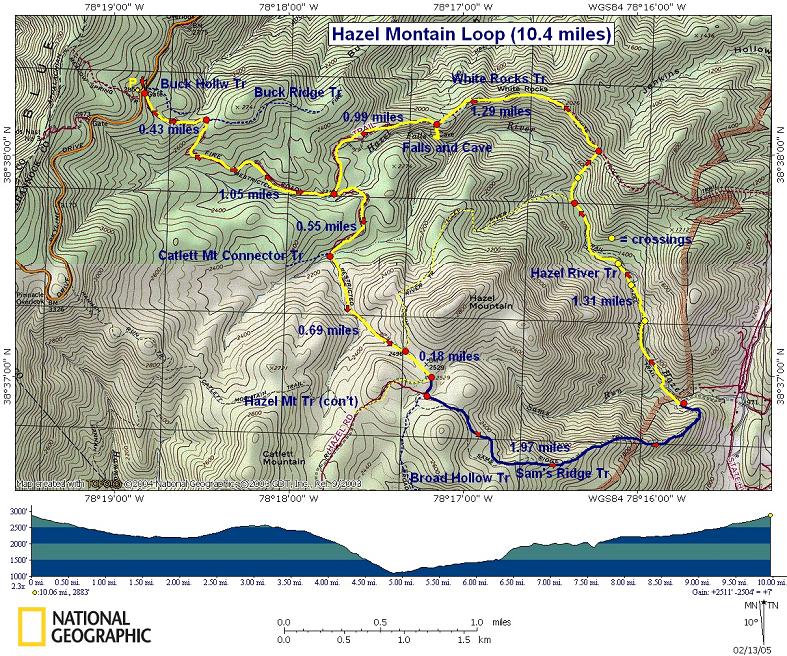
Trail Discovery for Kids: Hazel Mountain Trail, SNP
 |
| Waterfall and swimming hole |
May 2012 Highlighted Hike
Hazel Mountain Trail
Trail Description
ü This 5 mile out and back hike gently
descends the ridge top with its final destination being a cave and waterfall
off the White Rocks Trail.
ü The trail head is just after the 33
mile marker on Skyline Drive.
ü The total elevation loss and gain is
800 feet.
ü At the trail head, turn right onto the
Hazel Mountain Trail and descend the ridge line 600 feet for 1.6 miles until
you reach the trail intersection with the White Rocks Trail. Turn left on to
this trail. Follow it as it stays level with the ridge for three-quarters of a
mile. The White Rocks Trail then descends 200 feet the last quarter of a mile
before you reach a small sign on the right that point to the waterfall and
cave.
ü To access the cave and waterfall,
follow a steep and long set of stairs down the ridge (150 feet in .2 miles).
Both the waterfall and cave are to the right at the bottom of the stairs. Once
there, allocate an hour to discover the natural wonders.
ü You can reach the waterfall and cave
from the other direction on the White Rocks and Hazel River Trails from the
base of SNP on Rt. 600. Read August
2010 Discovery for Kids.
Age Appropriateness
This hike is
best for active children over the age of 6 due to the length, elevation gain
and the steepness of the stairs to the waterfall and cave.
What is fun for kids?
ü Finding and entering the mouth of the
cave. The Appalachian Mountains are littered with limestone caves.
ü Cooling off under the waterfall and
in the swimming hole.
ü Rock scrambling along the Hazel River
at the waterfall.
ü During spring, observe the
wildflowers, such as Dutchman's Breeches and Lady Slippers in April and
Mountain Laurel in May.
ü A few unofficial camping sites are
across the trail from the cave and waterfall trail head.
Caution
ü Don't venture too far into the cave.
It is best to explore caves with a guide (someone who knows the routes within
the cave), a guide line, helmet, head lamp and emergency supplies.
ü There are no bathrooms at the trail
head. The closest ones are 3 miles away at the Thorton Gap entrance station.
ü There are no trash cans; therefore,
trash must be packed out.
Friday, March 9, 2012
Trail Discovery for Kids: Muddy Branch Trail, Montgomery Co.
 |
| Wood Frog |
Muddy Branch Trail – River Road to Esworthy Road section
Darnestown, MD
Hike Information
ü The Muddy Branch Trail is 9 miles long from River Road at Blockhouse Point to Route 28.
ü The River Road to Esworthy Road section is a 3.4 mile out and back hike.
ü The trail meanders through park land along the Muddy Branch and up and down the stream valley.
ü The hike’s gentle elevation gain and lose is 175 feet.
ü The trail crosses two Muddy Branch tributaries without bridges or stepping stones.
ü This trail is NOT jogging stroller passable.
ü Use the Blockhouse parking lot on River Road. The Muddy Branch trailhead is across River Road to the right of the gas pipeline right-of-way.
ü Link to the trail map.
Age Appropriateness
ü This hike is best for children six years or older due to the hills and stream crossings.
What is fun for kids?
ü The trail sits just above the Muddy Branch flood plain which has many vernal pools. Hiking this trail in March and April provides a great opportunity to see and hear many kinds of amphibians. Dawn and dusk are the best times to sit quietly and take in the action.
ü Multiple opportunities to play in or alongside the Muddy Branch and its tributaries.
ü About halfway, there is a great spot with some large boulders along the Muddy Branch to sit and have a picnic or a snack.
Caution
ü Gas pipeline is adjacent to the parkland.
ü No bathrooms or trash cans; pack-in, pack-out your trash.
ü Feet may get wet during the two stream crossings.
Friday, July 1, 2011
Ohiopyle State Park: Pennsylvania’s Outdoor Mecca

For years, I have heard many great stories and comments about Ohiopyle StatePark in Southwestern Pennsylvania. My friend and I, two moms, packed her minivan with camping and rafting gear, bikes and our kids and off we went seeking outdoor adventures.
From Washington DC, Ohiopyle is a three hour drive and from Pittsburg, 90 minutes. Ohiopyle is located in the Laurel Highlands of Pennsylvania, an area lush and green, a temperate rainforest with a large tree canopy shading mountain laurel, rhododendron and ferns. Mountain streams fall from steep ravines and feed the Youghiogheny River. The river provides a white water adventure for children on class I and II rapids to thrill seeking adults who kayak or raft class IV and V rapids. Four companies in Ohiopyle provide guided and unguided trips. My daughter couldn’t wait to ride the rapids; however, it wasn’t in the cards. We experienced temps in the 60’s and rain that creates blue lips and shivering children. Not kid (or mommy) fun!
 We established home for three days in the state park: staking tents, spreading out chairs, hanging a hammock and setting-up the stove. Thank goodness for the tarp because it became our togetherness refuge under the raindrops. The girls stuck together in the two-person and my son hung with the moms. Each site provided a bit of privacy from the next and the bathrooms (showers in a separate house) were “not the best I’ve seen but not the worst,” said my daughter.
 Water play, rafting and riding the natural waterslides (video), didn’t make the agenda for the trip due to the weather. Instead, we wore pants and jackets, a great reprieve from the hot, humid temps in DC, to hike, bike, and visit Fallingwater, Frank Lloyd Wright’s incredible, organic architecture home built over Bear Run for the Kauffman family in 1936. This ingenious marvel is the epitome of what outdoor living should be, besides camping of course!
 We hiked and biked the Great Allegheny Passage, a rails trail from Pittsburg to Cumberland, MD. After establishing home and cooking dinner, we took a twilight hike down the ravine to the Passage to walk amongst the fog that enveloped the old railroad bridge above the Youghiogheny. We also biked in search of the many waterfalls on side trails along the Passage. My kids braved a STEEP downhill climb to one with me in nervous tow. Well worth the nervous climb!
So much to do in Ohiopyle State Park with not enough time. We will be back to raft or kayak, ride the natural water slides, mountain bike, rock climb and some day bike the entire Great Allegheny Passage. This trip created great memories. We look forward to more in Ohiopyle.
Subscribe to:
Posts (Atom)