Monday, July 9, 2012

Wildlife Wonders in Yellowstone and Grand Teton

Grizzly Bears
Pronghorn
Bison laying next to a thermal at Mud Volcano
Yellow-bellied Marmot
Red Fox
Female Sage Grouse
Mountain Bluebird
Male Moose
     For two weeks at the end of June, my family embarked on an amazing outdoor adventure to Yellowstone, Grand Teton and Rocky Mountain National Parks. After a few days in Grand Teton, my husband, kids and I started reflecting on the animals that we had seen thus far and were amazed at the list we had generated. Everyday afterwards, we added to that list.


Elk – male and female
Yellow bellied marmot - many along Jenny Lake
White pelican - on the Yellowstone River at Fishing Bridge
Moose - one at Willow Flats and one female and
male on our raft trip
Bison and bison calves - hundreds everywhere
but the most spectacular was in Lamar Valley
Snowshoe Hare
Coyote - surprised one while hiking the Howard
Eaton Trail along the Yellowstone River
Black bear - multiple times in Yellowstone
Osprey
Wood duck
Grizzly bear - two adult and one cub off the road 
near Canyon Village
Red fox
Wandering Garter Snake
Wolf - in distance at 8:45 pm near Pleasure Valley 
in Yellowstone
Pronghorn
Ground squirrel - these burrowing animals are everywhere
Sage grouse - on our hike up Bunsen Peak near Mammoth Springs
Mountain Bluebird - on our hike down Bunsen Peak near Mammoth Springs
Cinnamon black bear - side of the road at 9:30 pm on the pass south of Roosevelt Lodge
Bald eagle - on our raft trip down the Snake River in Grand Teton
Beaver - on our raft trip
Loon - kayaking Half Moon Bay on Jackson Lake
Bighorn Sheep (ewe) - Colorado River Trail in Rocky Mountain National Park

    I am so grateful to have been able to share this wildlife experience with my children, for them to understand that we are visitors in these animal's homes and that we must do everything in our power to respect and protect them and their habitats.

Note: These photos were taken with respect to the wildlife using a high power zoom lens.

Tuesday, July 3, 2012

Be Grizzly Bear Aware


This sign is on all bear boxes in Grand Teton and Yellowstone.
    Many people have written blog posts about camping in bear country. I am going to add another. I have spent many years camping and backpacking on the east coast. This summer, my family and I experienced camping in the west for the first time, in Grand Teton National Park. This is BEAR country. Being a Master Educator and MD State Advocate for Leave No Trace, I have learned and taught others about respecting wildlife when hiking and camping. Respecting wildlife includes recreating in bear habitat.
   There isn't a difference between how to camp and hike in bear country on the east as opposed to the west. However, there is a huge difference in the attitude and proactive education that is done by the National Park and people who live in grizzly country. Campers on the east receive minimal education on how to camp among wildlife. Most state and all National parks on the east post the Leave No Trace principals on trail head signs and in campgrounds. Some may extend beyond: to remind you to put food in a car or hang it when not in use, dispose of trash properly and stay a safe distance away from bears.
   I am sure many of you have heard the horror stories of people being attacked by bears, whether they suddenly come upon a mother and cubs or the bear enters a campsite wanting food. These scenes are unfortunately true but not prevalent. One reason is because many of the western National Parks are doing a fantastic job educating hikers and campers about being safe in bear country.
    "Be Bear Aware" is Grand Teton and Yellowstone National Parks bear safety educational campaign.
  Be Bear Aware educational displays include: a trailer at Willow Flats, display boards in all the visitor centers and campground offices, a pamphlet distributed at the entrance stations, an article in the Grand Teton Guide, posters in all park bathrooms, billboards in populated areas and placards on all park picnic tables. The message saturates the Park.
This sign is on all picnic tables in
Grand Teton and Yellowstone.
  At all campsites, picnic locations and strategically placed spots (where people tend to picnic along lakes and in scenic locations), large steel bear boxes are located for people to place their food.
  Bear proof trash and recycling cans are located in all populated locations.
  Rangers educate visitors at all presentations and activities.
  Rangers check campsites each evening, either receiving individual education or a warning notice when violating the bear safety rules. The warnings can include a paper notice of your violation, confiscation of your gear and/or a fine. On our first night in the Park, we received a warning notice because we left our site with the water bottles still on the picnic table.
  Each backpacker receives a bear canister when obtaining a backcountry camping permit with full instructions on how to use it.
Be Bear Aware includes:
  Never allow a bear to get food. If in the presence of a bear, store your food and move away to a safe distance.
  Place all food and scented items in a bear box or hard-sided car. These include: food, cooking dishes and utensils, coolers, water bottles and dispensers, drink cans and bottles, wash bins and soap, stoves and grills, toiletries and pet food. Never leave these items in your tent or out if not present.
  Never leave your backpack or dry bag, if on the water, unattended. Bears can swim!
  Dispose of all trash, even micro-trash, and recyclables in receptacles.
  Rat-out your fellow campers who are not following the bear safety rules. I did. At Jenny Lake, fellow campers left a grocery bag of garbage hanging in a tree. Yikes!
  When hiking, talk, sing or clap often to make your presence known (this is more effective than bear bells). Bears will move away when they hear people. Don't use head phones or ear buds when hiking. Hike in groups and during the day. Bears are most active at dawn, dusk and at night.
  Carrying and using bear spray is a proven strategy if charged by a bear. Carry it on your waistline for immediate use.
  If a bear approaches or charges you: first, DO NOT RUN; second, stand still. When bears charge, they will often veer off into the woods before attacking. If so, slowly back away once the bear is in the woods. Bears charge because hikers surprise them when they are protecting a food source or their young. If attacked, lie on your stomach with your legs slightly separated and your hands held together over the back of your head. Be silent and don't move. When the bear stops attacking and leaves, lie still for a few more minutes.
   Source - "Grand Teton Guide," Summer 2012
   The campgrounds, picnic areas, high use trails and scenic areas in Grand Teton were very clean; much more than ones on the east coast. Often campsites in state and national parks in the east have micro-trash scattered around, in the campfire pits and around picnic tables. Micro-trash is often also visible on high use trails. Contrary to many national parks in the west, trash, including micro-trash, is hard to find. I attribute this to the presence of bears, grizzly and black, and the educational campaign that saturates the minds of most visitors.
   It is important that people are proactive in their recreating practices to minimize the habitation of bears in our parks. A habituated bear is a dangerous one that must be killed. Bears are essential predators in their ecosystem's food web, in addition to being natural wonders. Before this trip, I considered myself knowledgable about recreating with bears. However, camping and hiking in the Grand Tetons and Yellowstone has allowed me to experience recreating in grizzly country and increased my awareness and knowledge to "Be Bear Aware."  

Saturday, June 16, 2012

Trail Discovery for Kids: Blue Mash Trail, Montgomery Co.


Bio-retention pond

June 2012 Highlighted Hike
Blue Mash Trail
Laytonsville, MD

Trail Description
ü  This 2 mile circuit hike in northern Montgomery County surrounds the long-closed Oaks Landfill and its reservoir system.
ü  The trail is a mowed-field path with no elevation gain or loss.
ü  Surrounding the trail is a meadow ecosystem with succession of immature deciduous trees, such as river birch, sycamore, red oaks and red maples, and conifer trees, mostly cedar, supported by a an understory of witch hazel and viburnum.
ü  The parking lot is on the west side of Zion Rd. in Laytonsville. It is marked by a small, brown sign labeled Blue Mash Trail.
ü  In the parking lot, use the trailhead at the end of the parking lot and hike the circuit counterclockwise. When reaching the reservoir, hike to the right counterclockwise one-third around it and then the trail will enter a tunnel of cedar and deciduous trees. Shortly after exiting this treed tunnel, make the second right at the trail intersection. At the second intersection, turn left with the landfill being on the right side. At the third intersection, turn right with the landfill continuing to be on the right. The trail will dead end and turn to the left on a gravel road. This will lead you back to the parking lot.
ü  To hike a shorter 1.25 mile circuit, turn left at the first trail intersection and continue straight at the third intersection essentially cutting of two sides of a triangle.
Tunnel of trees
ü  The hike is jogging stroller friendly.
ü  Trail map.

Age Appropriateness
This hike is appropriate for all ages due to a flat, wide trail that has no obstacles for feet or jogging strollers.

What is fun for kids?
ü  Kids and parents can fill their tummies with as many raspberries and blackberries as their heart’s desire. The trail is full of berry plants. The best time to go is the end of June into July.
ü  In May, the meadows are full of raspberry and blackberry flowers, buttercups, crown vetch, milkweed and sprouting Joe Pye weed which blooms at the end of the summer.
ü  The meadow invites a lot of butterflies, such as many varieties of swallowtail, monarchs, and skippers, and 32 different species of birds have been identified along the trail making it a great birding destination.
ü  Look for and listen to frogs and turtles along the reservoir.

Caution
ü  Because it is a sunny meadow with few shady spots, it is best to visit this trail on a day with lower temperatures or at the beginning or end of the day.
ü  Bring bug spray and wear long pants to help protect against ticks and gnats. 
ü  There is no bathroom or trash cans; therefore, pack out your garbage.

Wednesday, May 30, 2012

A Mama Ah Hah Moment!

    I am a competitive person. It is in my Chambers' genes and has been passed down for hundreds of generations that I am sure.   If I am not competing against another person than I am competing against myself - seeking the next best PR or one upping the last adventure. Until this weekend.
   This Memorial Day weekend, my son, six years old, and I biked and camped the C&O Canal in Western Maryland. We parked at Little Orleans and assembled our gear in a trailer graciously lent to me by a good friend. At noon, we mounted our bikes and headed five miles north to Devils Alley campsite. After pitching the tent and eating lunch, my intended goal was to bike ten more miles north to the Paw Paw Tunnel where I could share with him this unique engineering feat and the micro ecosystem that lays at its mouth. The competitive mama was in denial that my son was not going to be able to bike ten miles north and then back. I expressed my goal aloud and maintained my cheerleading stance throughout the ride to the campsite and then on our quest to the tunnel. We enjoyed the beautiful scenery, particularly the hundreds of butterflies, and I relished in the quality time I was spending with him. 
    Five miles into my goal to reach the tunnel, he stopped for the tenth time and announced, "I'm tired. Can we turn around?" Two voices went off in my head at the same time. 
   The competitive mama's voice said, "Oh, but we haven't reached our goal yet." 
   While the compassionate mama's voice said, "Okay, meet him where he's at for the positive experience and turn around." 
   Which voice made it out of my mouth? The competitive voice wrestled with the compassionate. "Are you sure you want to turn around?" 
   "Yes." he stated. 
   "Okay, we will visit the tunnel some other time, " the compassionate voice said. As we headed back to the campsite, he asked how many miles he had biked. Fifteen. "Hey, that is my personal best," he exclaimed with pride.

Tuesday, May 8, 2012

Dirty Knees

Dirty knees and sticky fingers!
    Dirty knees! These words conjure up a lot of images, particularly in the minds of moms who do a majority of the laundry. In my house that would be my husband; therefore, I wonder what images come to the forefront of his mind when he sees our kid's dirty knees.
    This weekend, my family and three others went camping in my favorite DC spot - Patuxent River Park, Jug Bay (read my May 2011 review of Jug Bay). Shortly after arriving on Friday evening, all eight kid's knees were dusty from running up and down the trail, kneeling on the dirty dock and sitting by the campfire to roast marshmallows. Saturday morning's bright sunshine brought aquatic adventures. The kids couldn't wait to get the rented canoes and kayaks to explore the abundant wildlife along the shore and show off their paddling skills to one another. They all negotiated who was going to kayak back to the dock by themselves and who was paddling a canoe; yes, with an adult. Upon reaching the campsite dock, negotiations continued.
    Most of us forgot that the Patuxent River is a tidal river and the tide was vacating the shore. Results, muck! Thick, dark grey muck - the kind that suctions everything that accidently falls on top of it. Including three girls. Well that was last year when two of them tried to walk along, what they thought was, the dry shore. Nope, they quickly sunk to their knees. The third tried to be the savior. That failed also. As parents, we watched the scenario unfolded, including problem solving to unsuction their limbs from the thick, dark quicksand. The clean-up job with no bathrooms was fun. Not! So this year when the tide was out by lunch time, the kids were hungry and wanted to dock. The life line was deployed and water skiing on mud took place.
     For me, kid's dirty knees mean they are engaging in imaginative adventures outdoors, laughing, smiling and being carefree and independent. The best part of the weekend was watching my kids and their friends be excited to create fun for themselves however they decided - following the inlet paths among the reeds on a kayak, using sticks as weapons to conquer an opponent or territory, sleeping in a tent without a parent, sharing a hammock or a seat on the dock to chat and learning to paddle a canoe to be the captain of your own ship. Dirty knees = outdoor happiness!

Monday, April 30, 2012

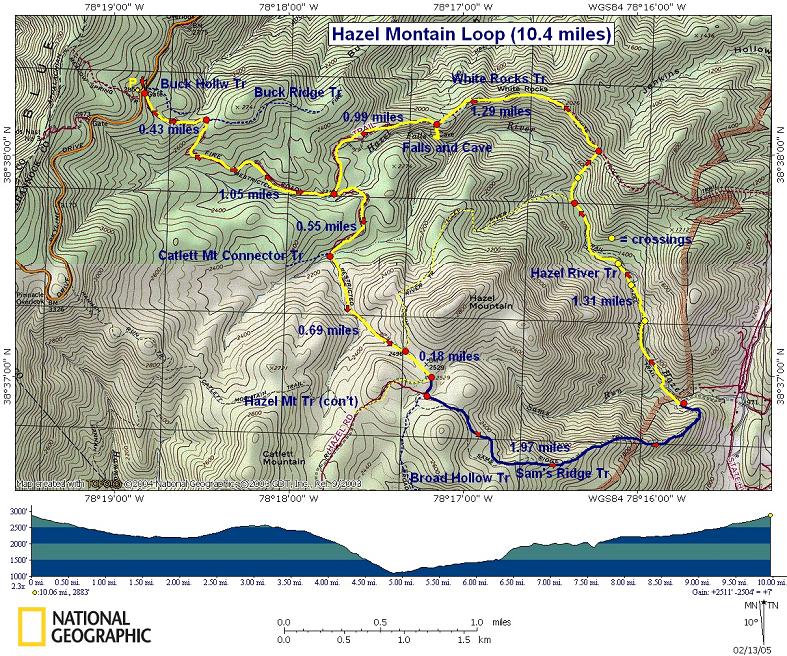
Trail Discovery for Kids: Hazel Mountain Trail, SNP


Waterfall and swimming hole

May 2012 Highlighted Hike
Hazel Mountain Trail

Trail Description
ü This 5 mile out and back hike gently descends the ridge top with its final destination being a cave and waterfall off the White Rocks Trail.
ü The trail head is just after the 33 mile marker on Skyline Drive.
ü The total elevation loss and gain is 800 feet.
ü At the trail head, turn right onto the Hazel Mountain Trail and descend the ridge line 600 feet for 1.6 miles until you reach the trail intersection with the White Rocks Trail. Turn left on to this trail. Follow it as it stays level with the ridge for three-quarters of a mile. The White Rocks Trail then descends 200 feet the last quarter of a mile before you reach a small sign on the right that point to the waterfall and cave.
ü To access the cave and waterfall, follow a steep and long set of stairs down the ridge (150 feet in .2 miles). Both the waterfall and cave are to the right at the bottom of the stairs. Once there, allocate an hour to discover the natural wonders.
ü You can reach the waterfall and cave from the other direction on the White Rocks and Hazel River Trails from the base of SNP on Rt. 600.  Read August 2010 Discovery for Kids.

Age Appropriateness
This hike is best for active children over the age of 6 due to the length, elevation gain and the steepness of the stairs to the waterfall and cave.

What is fun for kids?
ü  Finding and entering the mouth of the cave. The Appalachian Mountains are littered with limestone caves.
ü  Cooling off under the waterfall and in the swimming hole.
ü  Rock scrambling along the Hazel River at the waterfall.
ü  During spring, observe the wildflowers, such as Dutchman's Breeches and Lady Slippers in April and Mountain Laurel in May.
ü  A few unofficial camping sites are across the trail from the cave and waterfall trail head.

Caution
ü  Don't venture too far into the cave. It is best to explore caves with a guide (someone who knows the routes within the cave), a guide line, helmet, head lamp and emergency supplies.
ü  There are no bathrooms at the trail head. The closest ones are 3 miles away at the Thorton Gap entrance station.
ü  There are no trash cans; therefore, trash must be packed out.

Saturday, April 21, 2012

A Bug's Losing Battle


Female Brown-headed cowbird
  During this school year, I have led my middle school students on two nature journaling field trips to our local stream valley park. They journaled about what they observed during the fall and winter drawing connections between the Earth and sun relationship and how temperate climates respond during the seasons. During the field trips, students focused their observations and journaling on the macro, the landscape, because it is more literal to see what is in front of them. On Monday's field trip, I will ask them to observe a small creature for 10 minutes to gain insight on their habits of survival.

    Today, I had my own experience of observing a small animal to learn its relationship in the food web of my backyard. As I was pulling weeds in my vegetable garden, a female, brown-headed cowbird landed next to my rhubarb. My squat become a permanent statue.While removing the lesser celandine that dominate my garden, she drew closer and braver showing no inhibitions to the possibility that I could be a predator.  I could have reached out and grabbed her. My weed peeling revealed many pill bugs. However, she wasn't interested, maybe because they are all crust and no juice. She spotted a brown, quarter-sized spider and snatched it. She struggled with it for a few seconds before she crushed its body and devoured it. There is nothing like the predator prey relationship in nature, no matter how big or small the creatures. It is still fascinating to watch. She is not a carnivore but an omnivore, occasionally feasting on the plentiful helicopters that litter my yard. It is the bugs she preferred though. Saving the best for last, she caught sight of a bug larva. With precision, she plucked the cream-colored larva from the fresh soil. It wiggled to gain its freedom from her beak but lost the battle within milliseconds. Larva to birds are like gummy worms to kids; irresistible sweetness. As I noticed lactic acid build up in my quads, I didn't want to move for fear of missing the show. She occasionally tilted her head to the sky to check for predators, not being afraid that I could be one. After devouring the available protein, it was time for her to fill her tummy elsewhere in my neighborhood. She spread her wings and took off. My matinee performance ended with a smile.